VISION

Material For Exam

Recent Update

Monday, April 06, 2020

Daily Current Affairs, 06th April 2020

17:23


1) UN declares April 5 as International Day of Conscience

•The United Nations declares April 5 as International Day of Conscience. This day serves to remind people to self-reflect, follow their conscience, and do the right things. April 5, 2020, will mark the first International Day of Conscience, which is a United Nations day.

•The designation of April 5 as the International Day of Conscience serves to remind people to engage in self-reflection to improve themselves and their communities, stimulating a crucial turning point for transforming our world. Conscience empowers people to tolerate, forgive, and love one another, and thus it shortens the distance between people and between nations.

History of International Day of Conscience:

•On February 5, 2019, Federation of World Peace and Love (FOWPAL) launched a global endorsement campaign for the Declaration of International Day of Conscience at the United Nations in New York. To date, the declaration has been translated into 41 languages and endorsed by people in 185 nations. On July 25, 2019, during its 73rd session, the United Nations General Assembly adopted a draft resolution submitted by the Kingdom of Bahrain, entitled “Promoting the Culture of Peace with Love and Conscience,” declaring April 5 the International Day of Conscience.

2) Nation celebrates 57th edition of National Maritime Day

•National Maritime Day in India is observed on 5 April every year. This year is 57th edition of the National Maritime Day. The National Maritime Day is celebrated every year day to illustrate the awareness in supporting intercontinental commerce and the global economy as the most well-organized, safe and sound, environmentally responsive approach of transporting goods from one corner to another corner of the world.

3) 6 April observed as International Day of Sport for Development and Peace

•The United Nations celebrates 6th of April every year as the International Day of Sport for Development and Peace. Sport has historically played an important role in all societies, be it in the form of competitive sport, physical activity or play. Sports also presents a natural partnership for the United Nations (UN) system.

•To celebrate International Day of Sport for Development and Peace 2020, the United Nations requests people around the world to be active, stay healthy and exhibit solidarity during this period of physical and social distancing as this team spirit is going to help us all in getting through the current challenges together. In year 2020, responding to global developments concerning the COVID-19 pandemic, the UN is stressing on the health benefits of participating in sporting and physical activity, especially in the present time of uncertainty and social distancing.

•For the International Day of Sport 2020, the UN has appealed to people to #BeActive and healthy to beat #COVID19.

4) Civil servants launch ‘Caruna’ initiative to fight Coronavirus

•Civil services officers’ associations have formed an initiative called ‘Caruna’ to support and supplement the government’s efforts in fighting coronavirus. The acronym ‘Caruna’ stands for Civil Services Associations Reach to Support in Natural Disasters.

•The platform includes officers from the Indian Administrative Service (IAS), Indian Police Service (IPS), Indian Foreign Service (IFS), Indian Revenue Service (IRS), state services and so on. This platform was launched by the IAS Association vice-president Sanjeev Chopra.

5) PM, President and MPs Salary Cut by 30% , MPLAD funds suspended for 2 years
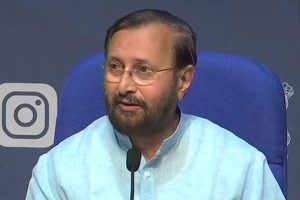


•The Union Cabinet approved an ordinance amending the salary, allowances and pension of Members of Parliament Act, 1954, to reduce the allowances and pension by 30% starting April 1, 2020, for a year. All Members of Parliament (MPs), including Prime Minister Narendra Modi and his Council of Ministers, would be taking a 30 per cent salary cut due to the impact of the novel coronavirus.

•Indian President, Vice President and all state governors have voluntarily decided to take a 30 per cent salary cut for a year in view of the coronavirus outbreak and the expected downturn in the economy.

•The cabinet also approved temporary suspension of MPLAD (Member of Parliament Local Area Development) fund scheme during 2020-21 and 2021-22, and the funds will be used for managing health services and the adverse impact of COVID-19 pandemic in the country. Rs 7,900 crore from the MPLADS scheme will go to Consolidated Fund of India. The Rs 10 crore from each MPLAD fund will now go to the Consolidated Fund of India for “managing health and the adverse impact of the outbreak of COVID-19 in India”. India is under a 21-day nationwide lockdown to mitigate the spread of the novel coronavirus.

6) ‘V Safe Tunnel’ installed in Telangana to sanitize people
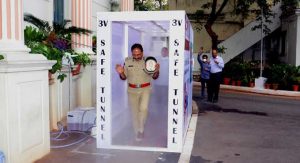
•‘V Safe Tunnel’ has been installed in Telangana to sanitize people. The sanitising tunnel has been installed at the state Director General of Police’s office. A unique disinfectant named ‘V Safe Tunnel’ sanitizes people from any possible bacteria and other microbes within 20 seconds.

•The ‘V Safe Tunnel’ aims to minimise the local transmission of Coronavirus in the state by providing maximum protection to people passing through the tunnel in around 20 seconds. It includes a combination of a water-soluble polymer and iodine in a form of spray and is known to be effective against virus such as SARS and Ebola.

7) CM Naveen Patnaik honoured by Peta India for feeding animals
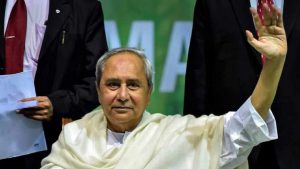
•Chief Minister of Odisha, Naveen Patnaik has been conferred with ‘Hero to Animals Award’ by animal rights body PETA India. He has been awarded by People for the Ethical Treatment of Animals (PETA) for allocating funds to feed community animals in Odisha during the lockdown over the novel coronavirus pandemic.

•The lockdown has not only affected people but animals as well. In the concern that the animals do not go starving in such conditions, CM approved of Rs 54 lakhs from a relief fund to feed animals of the community. The initiative undertaken to feed animals are conducted in five municipal corporations and all 48 municipalities of Odisha.

8) Madhabi Puri Buch gets 6-month extension as WTM at SEBI
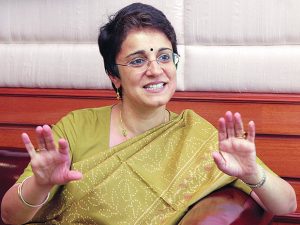
•The term of Madhabi Puri Buch as a Whole Time Member (WTM) at Securities and Exchange Board of India (SEBI) has been extended by 6 months. Madhabi Puri Buch is the first woman Whole Time Member (WTM) of SEBI and also the first from the private sector to be appointed as a board member in SEBI.

•Madhabi Puri Buch was appointed as the Whole Time Member (WTM) at Securities and Exchange Board of India in 2017 with a three-year tenure, while other WTMs of SEBI were appointed for the duration of five years.

9) IAF airlifts essential drugs to Maldives under ‘Operation Sanjeevani’

•The Indian Air Force (IAF) has launched ‘Operation Sanjeevani’ and air-lifted 6.2 tonnes of essential medical supplies to the Maldives via transport aircraft C-130J as assistance in the fight against the COVID 19.

•India has supplied 6.2 tonnes of essential medicines to the Maldives as assistance in the fight against The medicines were procured from various cities and delivered by a Hercules aircraft of Indian Air Force. India has also supplied essential food grains and edibles despite logistical challenges in the wake of lockdown. The neighbouring country is mostly dependent on imports from India for such supplies.

10) Empowered Group for coordinating COVID-19 related Response Activities
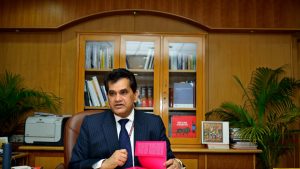
•The Government of India has constituted an Empowered Group for coordinating response activities with Private Sector, NGOs and International Organisations related to COVID-19.

•This group which will coordinate response activities with Private Sector, NGOs and International Organisations related to COVID-19, will be headed by the chief executive officer (CEO) of NITI Aayog Amitabh Kant. The group will address the issues involving identification of problems, effective solutions and making of plans along with three groups of stakeholders.


Read More

UPSC Prelims 2020 Crux Of Indian Economy PDF Notes Download

14:59


UPSC Prelims 2020 Crux Of Indian Economy PDF Notes Download


Read More

The HINDU Notes – 06th April 2020

14:42

📰 Reducing farm distress during a pandemic

The government has an opportunity to help farmers who are battling declining demand and lower prices

•Social distancing and living under a lockdown appear to be the only effective ways of dealing with the pandemic. As India lacks the resources to significantly ramp up testing, imposing a lockdown was the government’s preferred option. Although there is limited evidence to suggest that this strategy may be working in containing the spread of the virus, its after-effects on thousands of migrant workers is already out in the open. Distrustful of the government’s promise of providing support, most migrant workers decided to walk back to their home States despite efforts by the state machinery to prevent them from moving out.

Impact on agricultural income

•Migrants are not the only ones who are facing the after-effects of the lockdown. With the economy coming to a complete halt in most of the informal and formal enterprises in urban areas, the lockdown is also likely to affect the large population in rural areas, a majority of whom are dependent on agriculture. At a time when the rural economy was witnessing declining incomes, both for casual workers and self-employed workers, even before the pandemic broke out, this lockdown is only going to hurt the agricultural economy further. Even before the lockdown, rural wages were declining in real terms but there were hopes for agricultural incomes rising with food prices rising until January 2020. However, recent data on prices suggest that the trend is reversing with the decline in agricultural prices in most markets.

•In the short run, we will likely witness a breakdown of supply chains of agricultural produce with no facilities for transportation of produce. This is likely to hurt those engaged in the production of fruits and vegetables, which are perishable goods and cannot be stored. With horticultural production exceeding foodgrain production in the last decade, many farmers are likely to face uncertain or no markets for their produce. Media reports have already confirmed that farmers are finding it difficult to dispose horticultural produce. Some of them have taken the extreme step of destroying their produce.

•There will also be short-term impacts on foodgrains and other rabi crops that were ready to be harvested at the beginning of April. In some cases, harvesting may be postponed but it is difficult to do so beyond a week or a fortnight. While the government has exempted operation of agricultural markets and mandis from the lockdown, it will be difficult for farmers to harvest the agricultural produce in the surplus States of Punjab, Haryana and Uttar Pradesh in the absence of migrant labourers. Even if standing crop is harvested, April is the labour-intensive month. Labourers are required for packing, processing, transporting and selling the produce. This year is expected to register a record in the production of cereals, pulses, cotton and oilseeds. Most of these are labour-intensive crops and the absence of working labourers during the harvest and post-harvest season is likely to affect the prospect of higher incomes in agriculture.

•Some of the short-term impacts may affect price realisation by farmers but the real worry for farmers is going to be the decline in prices for the majority of agricultural produce. There are already signs of a collapse in agricultural prices, which predates the outbreak of the pandemic. The food price index of the Food and Agricultural Organization, which was showing a rising trend in food prices until January 2020, reported a 1% decline in prices month-on-month in February 2020. This is likely to worsen further, particularly for cash crops. It is well-known that commercial crop prices follow a similar pattern as other primary commodities, particularly petroleum prices. With the sharp decline in petroleum prices, most of the commercial crops have seen a downward pressure on prices, which is likely to worsen in the coming months. But even for foodgrains and other crops, there is likely to be downward pressure on prices due to declining demand. The slowdown in the economy domestically and the expected recession worldwide will contribute to lower demand for agricultural commodities. At a time when the agricultural sector was already battling declining demand and lower prices, the faint hope of better prices appears unlikely to materialise. It is the decline in prices which is likely to hurt the income of farmers in the long run more than the short-run supply disruptions and labour shortages.

What the government can do

•While it is clear that agriculture will be affected due to short-term disruptions and the long-term economic impact of the pandemic, there is an opportunity for the government to help farmers through state support. Political expediency and fiscal concerns led the government to stock up foodgrains, with the Food Corporation of India (FCI) reporting 77 million tonnes of cereals in stocks as against the buffer requirement of 21 million tonnes as on April 1. However, with the lockdown forcing a humanitarian crisis and with most migrants heading back to the rural areas, it is also time for the government to release the food stocks through the public distribution system. The Central government has already announced that for the next three months, 5 kg of free grains will be distributed in addition to what people are entitled to under the National Food Security Act, but this has not yet reached the State governments due to the lockdown. While this may free up FCI godowns to some extent, it will be prudent to extend the scheme to all residents, particularly migrants who may not be able to avail of free grain in urban areas.

•While raising procurements is desirable and may be necessary for the forthcoming rabi crops, the state is also expected to intervene and assure remunerative incomes to farmers. One way of ensuring this is to reduce the input costs through existing schemes of subsidies such as the fertilizer subsidy and through price reduction in petrol/diesel meant for agricultural purposes. But for the immediate short-term, farmers need to be compensated for the loss of income and the best way to do it is through the PM-KISAN scheme. Unfortunately, the only announcement in this regard is the disbursal of the first installment of the transfer which is due in April. However, the scheme only used two-thirds of its budget allocation for 2019, so efforts should be made to not only enhance the coverage monetarily but also include tenant farmers and wage labourers who are as much dependent on agriculture as the land-owning cultivators. Such a step is necessary not just for the survival of the agricultural sector but also for the overall economy which is expected to see a sharp slowdown and decline in demand. While income transfers may not be the best way of supporting the agricultural sector at times like these, they are the best available instruments to raise rural incomes and create demand.

📰 A niggardliness that is economically unwarranted

Read More

Vision IAS PT 365 Prelims 2020 Economy in Hindi PDF Download

14:26
Vision IAS PT 365 Prelims 2020 Economy in Hindi PDF Download


JOIN UPSC MATERIALS TELEGRAM--CLICK HERE

Click Here to download Vision IAS PT 365 Prelims 2020 Economy in Hindi
Click Here to Like our Facebook page for latest updates and free ebooks


Read More

THE HINDU NEWSPAPER IMPORTANT ARTICLES 06.04.2020

Sunday, April 05, 2020

The HINDU Notes – 05th April 2020

16:23


📰 Coronavirus | Grounding of planes partially hits IMD’s weather data supply

Data relayed from aircraft on temperature and wind speed are used in dynamical models

•The grounding of the country’s civilian aircraft has strangled a key source of weather data that the India Meteorological Department (IMD) uses for its forecasts. Officials, however, clarified that India’s annual monsoon forecast system was on track, with the first forecast scheduled to be issued in mid-April.

•Aircraft relay data about temperature and wind speed in the upper atmosphere to meteorological agencies the world over and this is used in the dynamical models, the ones which are run on super computers and relied on to give weather forecasts three days, or even two weeks ahead. “Inputs from aircraft are important for the dynamical models as it determines the initial conditions for these models,” D.S. Pai, chief forecaster, IMD Pune, told The Hindu. “However for the monsoon forecast, which is a long-term forecast, this isn’t significantly affected.”

•Beginning mid-March, India began restricting incoming international flights into the country and by March 24 had imposed a total shutdown on domestic air travel as well.

•This year, the IMD will likely rely on its traditional statistical forecast system — the workhorse, developed on the basis of historical data. India had begun to move away from this system and started to rely on its dynamical models as it better captures developing changes in the atmosphere. However, India’s dynamical models are still not as adept as meteorologists want them to be, for warning of a drought or extreme changes in monsoon rainfall. That, and limited data from aircraft as well as a general decline in land-based observations because of a shortage of manpower to send observations are forcing the agency’s hand.

•“We need multiple observations from weather stations from all parts of the country,” said Madhavan Rajeevan, Secretary, Ministry of Earth Sciences (MoES). “Now that’s been reduced. But because weather services are an essential service we are working with reduced manpower,” he added. The IMD is a subsidiary of the MoES. A major factor for gauging the performance of the monsoon is the El Nino, a warming of the ocean waters in the equatorial Pacific Ocean. This data is measured by observational data buoys located in the sea and relayed via satellite. “This data isn’t affected so far,” Dr. Pai said. The IMD issues its first forecast for the June-September monsoon in April and updates it in June.

•Aviation-generated data is also helpful to warn of developing thunderstorms or swings in temperatures that often begin at the heights aircraft traverse. “There are mathematical fixes that can be used to compensate for this. However, a lack of data for a prolonged period of time is a big loss for calculating weather trends and future climate patterns,” the IMD scientist added.

📰 Why has India reacted to declining global crude prices by raising excise duties?

Read More

Shubhra Ranjan Economy MCQ 2020 ECO-500 PDF Download

10:54
Shubhra Ranjan Economy MCQ 2020 ECO-500 PDF
Click Here to download Shubhra Ranjan Economy MCQ 2020 ECO-500 PDF

Click Here to Like our Facebook page for latest updates and free ebooks

Read More

THE HINDU NEWSPAPER IMPORTANT ARTICLES 05.04.2020

Forum IAS Prelims 2020 CSAT Test 07 With Solution PDF

06:32

Forum IAS Prelims 2020 CSAT Test 07 With Solution PDF


Read More

GS SCORE Target PT 2020 Environment PDF

06:25
GS SCORE Target PT 2020 Environment PDF
GS SCORE Environment 2020: Target PT 2020 Yearly Current Affairs


JOIN UPSC MATERIALS TELEGRAM--CLICK HERE

Click Here to download GS SCORE Target PT 2020 Environment PDF
Click Here to Like our Facebook page for latest updates and free ebooks


Read More
