1) Nirmala Sitharaman attends the 2nd G20 FMCBG Meeting
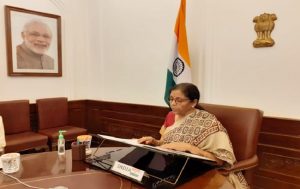
•Union Minister for Finance & Corporate Affairs, Nirmala Sitharaman represented India in the virtual session of the 2nd G20 Finance Ministers and Central Bank Governors (FMCBG) meeting. The 2nd G20 Finance Ministers and Central Bank Governors (FMCBG) meeting was held under the presidency of Saudi Arabia. The prime objective of the meeting was to discuss the global economic outlook amid advancing COVID-19 pandemic crisis. Key takeaways of the 2nd G20 Finance Ministers and Central Bank Governors (FMCBG) meeting: •Union Minister for Finance & Corporate Affairs, Nirmala Sitharaman emphasized the role of Finance Ministers as well as Central Bank Governors to safeguard the lives and livelihood of people, and at the same time, maintaining the macroeconomic stability in a sustainable manner. •During the meeting, the minister also shared the measures taken by Government of India to facilitate the vulnerable sections with swift, timely and targeted assistance. •G20 members has also shared an Action Plan to combat COVID-19 in order to protect lives, safeguard people’s jobs and incomes, preserve financial stability, revive growth and recover stronger. The shared action plan also aims to restore the confidence, provide help to countries needing assistance, coordinate on public health and financial measures and minimise disruption to global supply chain.
2) 44th session of UNESCO’s World Heritage Committee postponed
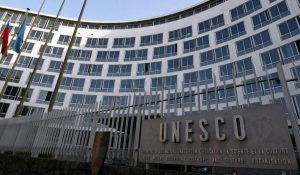
•The 44th session of the World Heritage Committee of UNESCO has been postponed due to the impact of the COVID-19 pandemic. The session which will be hosted by the Chinese government, was scheduled to be held in Fuzhou of eastern China’s Fujian Province from 29th June to 9th July 2020. •The Organizing Committee’s bureau members took the decision unanimously to postpone the 44th session of the World Heritage Committee of UNESCO keeping in view the novel coronavirus outbreak. The announcement of the decision was made by China’s Ministry of Education.
3) Andhra Govt launches YSR Nirman and COVID-19 portals
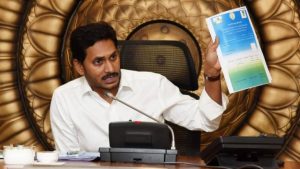
•COVID-19 portals to fight against Coronavirus pandemic. How does YSR Nirman portal work? •The YSR Nirman is a web platform to assist various departments to acquire cement. The buyers (various government departments) can seek the number of cement required from suppliers for various government projects like Polavaram, housing etc. This portal connects various stakeholders like Cement Manufacturers Association, manufacturing companies and government departments. How does COVID-19 portal work? •The AP Industries COVID- 19 portal enables the MSME manufacturers and suppliers within the State to register themselves. The manufacturers and suppliers with UAM and GST can register themselves within the portal for creating and supplying essential items associated with COVID-19, both medical and auxiliary.
4) US approves sale of Anti-ship Missiles & Torpedoes to India
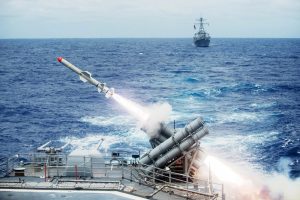
•The United States has approved the sale of Harpoon air-launched anti-ship missiles and Mark 54 lightweight torpedoes to India. The step has been taken by the Trump administration to enhance India’s deterrent capabilities against “regional threats” and also to strengthen its homeland defence.
•The Defense Security Cooperation Agency has stated that the sale of 10 AGM-84L Harpoon Block II air-launched missiles, 16 MK 54 All Up Round Lightweight Torpedoes and three MK 54 Exercise Torpedoes are estimated to cost USD 155 million. •To conduct the anti-surface warfare missions in defence of critical sea lanes, the Harpoon missile system would be integrated into the P-8I anti-submarine warfare aircraft, hence enhancing the inter-operability with the United States and other allied forces. The induction of MK 54 Lightweight Torpedo will enhance India’s capability to conduct anti-submarine warfare missions.
5) DST rolls out Integrated geospatial platform “SAHYOG”
•The Department of Science and Technology (DST), Government of India, has rolled out an Integrated Geospatial Platform known as “SAHYOG”. This integrated geospatial platform aims to help in decision making during the present COVID-19 outbreak and support with area-specific strategies in order to handle the socio-economic impact in the recovery phase. The mobile application SAHYOG will also complement the “AAROGYA-SETU” mobile application for Contact tracing, Public awareness, and Self-assessment objectives. About Integrated Geospatial Platform: SAHYOG •The Integrated Geospatial Platform “SAHYOG” has been created by the Department of Science and Technology from the available geospatial datasets, standards-based services, and analytic tools. It has been rolled out in the form of mobile application as well as the web portal (https://indiamaps.gov.in/soiapp/). SAHYOG will bolster the public health delivery system of the State as well as Central Governments and facilitate the necessary geospatial information support to citizens and agencies by collecting the COVID-19 specific geospatial datasets via community engagement. This is expected to speed up the response activities by Government of India against the pandemic. •Hence, the “SAHYOG” platform will support the Nation’s health emergency management in response to the COVID-19 outbreak.
6) Vineet Arora becomes new MD & CEO of Paytm General Insurance Ltd
•Paytm has appointed Vineet Arora as new managing director and chief executive officer of Paytm General Insurance Ltd. Prior to this, he has served as managing director and chief executive officer of Aegon Life Insurance Company. The appointment is a step for Paytm to further its journey into the insurance sector with an instantaneous specialise in general insurance.
7) Abdelouahab Aissaoui bags 13th International Arab fiction prize 2020
•Algerian writer Abdelouahab Aissaoui wins 13th International Arab fiction prize 2020. They awarded for his novel ‘The Spartan Court’ published by Dar Min in 2018. He will receive USD 50,000 and funding will be provided for the English translation. •‘The Spartan Court’ is a historical novel that relates the power struggle between Ottoman and French colonial powers in Algeria where it interconnects the lives of 5 characters in Algiers at the beginning of the 19th century (1815 to 1833).
8) Tata Power wins Edison Award for social innovation
•Tata Power bags Edison Award for social innovation. The company bags the awards for its ‘Club Enerji #Switchoff2SwitchOn’ campaign. It has brought about 533 participating schools across India, saving over 29.8 million units of power since its inception in 2007. •Tata Power is India’s largest integrated power company and has an installed capacity of 10,763 megawatts together with its subsidiaries and jointly controlled entities.
Australia
has one of the best education systems. Being enrolled in an Australian graduate
program means you have to do research. In an undergraduate program, you are
expected to do many assignments. If you are studying an exact science
(astronomy, physics, etc.), you will have to do much technical work.
However,
sometimes you may be overwhelmed by so much homework. In such a situation, you
are better off looking for assignment help for Australian students. Good news,AU.Assigncode.com can help
you with any technical assignment. You have to pay for the service, but their
fees are reasonable.
If
you pay someone to lend a hand, you want the best service for your money, don’t
you? This is why AU.Assigncode.com is the perfect solution if you need help to
complete a technical assignment. They have specialists in all the technical
subjects. Moreover, their specialists are well versed in algebra and
statistics, necessary math tools for any technical assignment.
Pandemics have triggered the collapse of empires, weakened pre-eminent powers and institutions, created social upheaval and brought down wars
•Pandemics have had great influence in shaping human society and politics throughout history. From the Justinian Plague of sixth century to the Spanish flu of last century, pandemics have triggered the collapse of empires, weakened pre-eminent powers and institutions, created social upheaval and brought down wars. Here’s a look at some of the deadliest pandemics and how they influenced the course of human history.
Justinian Plague
•One of the deadliest pandemics in recorded history broke out in the sixth century in Egypt and spread fast to Constantinople, which was the capital of the Eastern Roman (Byzantine) Empire. The plague was named after the then Byzantine Emperor Justinian. The outbreak, which spread from Constantinople to both the West and East, had killed up to 25 to 100 million people. The plague hit Constantinople when the Byzantine Empire was at the pinnacle of its power under Justinian’s reign. The Empire had conquered much of the historically Roman Mediterranean coast, including Italy, Rome and North Africa.
•The plague would come back in different waves, finally disappearing in AD 750, after weakening the empire substantially. As the Byzantine Army failed to recruit new soldiers and ensure military supplies to battlegrounds in the wake of the spread of the illness, their provinces came under attack. The plague had also hit Constantinople hard economically, substantially weakening its war machine. By the time plague disappeared, the Empire had lost territories in Europe to the Germanic-speaking Franks and Egypt and Syria to the Arabs.
Black Death
•The Black Death, or pestilence, that hit Europe and Asia in the14th century was the deadliest pandemic recorded in human history. It killed some 75 to 200 million people, according to various estimates. In early 1340s, the plague struck China, India, Syria and Egypt. It arrived in Europe in 1347, where up to 50% of the population died of the disease. The outbreak also had lasting economic and social consequences.
•In the words of Stanford historian Walter Scheidel, pandemics are one of the “four horsemen” that have flattened inequality. The other three are wars, revolutions and state failures. In his book, The Great Leveller”, Mr. Scheidel writes how the Black Death led to improved wages for serfs and agricultural labourers. “Land became more abundant relative to labour [after the death of millions of working people]. Land rents and interest rates dropped... Landowners stood to lose, and workers could hope to gain,” he writes. In parts of Europe, wages tripled as labour demand rose. And once the economy started improving, the landowning class pressured authorities to check rising labour costs. In England, the Crown passed legislation in this regard the tensions created by which would eventually lead to the Peasant Revolt of 1381. The pandemic also led to largescale Jewish persecution in Europe. Jews, blamed for spreading the illness, were burned alive in many parts of the continent.
•The most significant impact of the Black Death was perhaps the weakening of the Catholic Church. As Frank M. Snowden, a Yale professor and author of Epidemics and Society: From the Black Death to the Present, observed, the outbreak challenged man’s relationship to God. “How could it be that an event of this kind could occur with a wise, all-knowing and omniscient divinity?” he said in a recent interview. The Church was as helpless as any other institutions as the plague spread like wildfire across the continent, which shook the people’s faith in Church and the clergy. While Church would continue to remain as a powerful institution, it would never regain the power and influence it had enjoyed before the outbreak of the plague. The Protestant Reformation in the 16th century would further weaken the Church.
Spanish Flu
•Spanish Flu, which broke out during the last phase of First World War, was the deadliest pandemic of the last century that killed up to 50 million people. The flu was first recorded in Europe and then spread fast to America and Asia. India, one of the worst-hit by the pandemic, lost between 17 and 18 million people, roughly 6% of its population.
•One of the major impacts of the outbreak was on the result of the war. Though the flu hit both sides, the Germans and Austrians were affected so badly that the outbreak derailed their offensives. German General Erich Ludendorff in his memoir, My War Memories, 1914-18, wrote that the flu was one of the reasons for Germany’s defeat. Germany launched its Spring Offensive on the western front in March 1918. By June and July, the disease had weakened the German units. “Our Army had suffered. Influenza was rampant...It often left a great a greater weakness in its wake than the doctors realised,” he wrote. The Armistice was signed on November 11, 1918 that ended the War. But the flu would continue to ravage parts of the world for many more months.
COVID-19
•It’s too early to say how the COVID-19 outbreak that has already infected about 2 million and killed over 1,26,000 people would change the world. But the outbreak has seen countries, both democratic and dictatorial, imposing drastic restrictions on people’s movements. The western world, the centre of the post-World War order, lies exposed to the attack of the virus. Unemployment rate in the U.S. has shot up to the levels not seen since the end of Second World War. Governments across the world, including the U.S. administration, are beefing up spending to stimulate an economy that shows signs of depression. Radical changes, good or bad, are already unfolding.
UPSC Press release notice for upcoming UPSC exams, Including UPSC Civil Services Prelims Exam 2020.
UPSC Civil Services IAS Prelims Exam 2020 is scheduled to be held on 31st May, 2020. A special meeting of the Commission was held on April, 15, 2020 to review the situation arising out of the Corona Virus pandemic.
As per the notice released by the commission at its official website: UPSC Civil Services Prelims Exam 2020, Engineering Services (Main) and the Geologist Services (Main) Examinations will be conducted on the date announced by the commission. This means that these exams are on time, the commission also added that it can reschedule these exams if necessitated by the evolving situation.